Hi, this question is about how to use Photolab 9 to mimic a filter effect.
In the past I have used a “Red Enhancer” or “didymium” filter when photographing fall foliage. Example: Hoya RA54. The filter enhances reds, yellows, and browns without significantly affecting other colors. I wonder if there might be a PL preset or a certain procedure that would allow me to shoot without the filter and then recreate that effect in PL? Would like to hear thoughts and suggestions from others.
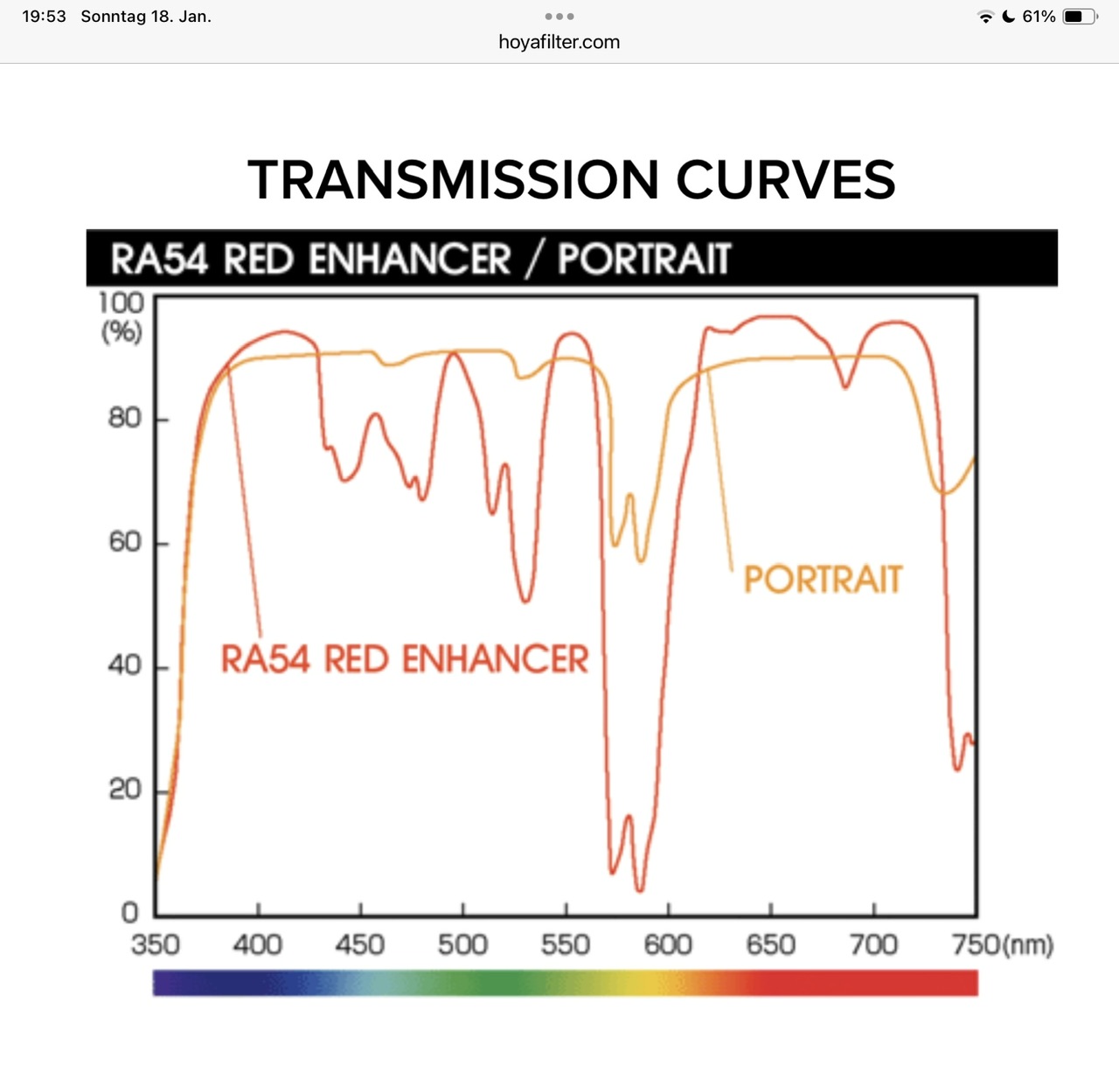
HSL should be able to approximate the properties except for the finer ripples of the curve. The most evident part is the notch for yellow. Once the desired effect is reached, a partial preset can be created.
As suggested above, you may try to use to use HSL, starting with Orange range, tuning the “inner” and “outer” ranges, reducing Luminance and experimenting with Saturation, Uniformity, and hue shift. Maybe you would have to do it additionally in some yellow range shrinked a bit towards greens. However, don’t expect the settings to emulate well this Hoya filter in all lighting situations. Maybe if you are interested in “fall colors” only, some preset may work for most of your cases, still being just an approximate. Note that preset may depend on colorspace and camera.
Question for DxO: Could you provide a utility which would generate camera/filter profile for supported camera and a given glass filter spectral response (input data format to be defined)?
Off topic: Did you try this filter with HPS lamps?
I have in mind people in old urban areas at night. There are still a few of these terrible sodium lamps around me here and perhaps HA54 could be useful (?). Any WB and exposure hints in this case?
Thanks for letting me/us know about the filter and @Platypus for its spectral response – really interesting.
Sodium lamps emit almost nothing but orange light (low pressure variety) or a mix of narrow band peaks depending on other elements added (high pressure variety). Taking photos under such light therefore produces images that are ± monochromatic.
Here, sodium lamps were used on intersections to make them stand out against ordinary street lighting. But the city is now replacing metal vapour lights by LEDs - for even higher efficiency and therefore reduced power consumption.
That’s what my (off topic) question was about – how HA54 behaves under this lighting conditions with respect to Caucasian skin tones. This filter is supposed to supress the sodium spectral peak at 589nm. After all it’s the reason why it was named “Didymium”. I just wonder if it’s practical for HPS lights use (i.e. if it’s “Didymium enough”) and whether I should give it a try. E.g. will I be able to restore skin tones?
Similar here, but you have some places with “spiky” lights, e.g. for indoor events a mixture of old mercury energy saving lights combined with early LEDs, kind of disaster for photographers. It’s getting better in general, but still one has to adapt. Do you have any good read about the rules/trends for public places lighting in EU?
I started this topic because I find filters a hassle in the real world, and would prefer to forgo the filter iff (note spelling) I could get close in post. I see it will be a work in process.
To all that have replied thx very much for taking time to do so. I would also second @Wlodek’s request:
Hey, DXO, “Could you provide a utility which would generate camera/filter profile for supported camera and a given glass filter spectral response (input data format to be defined)”
The narrow spectrum of a low pressure sodium vapour lamp will give you an image in which everything except orange is pretty much absent - minus the effects of relatively wide red and green filters of sensors. Under these conditions, skin can look okay-ish but in general, I’d use such light for B&W only. Anyways, go ahead and try it, considering that most street lighting is all but optimised to render colours nicely.
LP sodium vapour lamps are/were also used in the darkroom. If you happen to have such a lamp, you can try it indoors. HP sodium…bulbs can be found, mostly with 100W and more. They usually contain other ingredients and might give a wider, spiky/comblike spectrum. Not ideal for portraiture either.