Actually, I do use the silent shutter to avoid vibration in studio settings, whilst tethering to my laptop.
And thank you for your post, which led me to search for anything I might have missed on SL mode and found this video, which explains very well the limitations of doing LiveView photography with silent mode.
I apologize, as I obviously didn’t spend enough time to properly reply to each of your questions. Can you please ask again, with as many questions as you want, but PLEASE put a number in front of each of them that you want a reply to.
I will return here later this afternoon, to reply to any and all questions from anyone asking.
Sorry - I was feeling a bit overwhelmed last time.
I am not making arguments, just replying to questions. For things I haven’t yet tried, or don’t know yet, that’s the most I can do. For four days now, I’ve been shooting the D780 exclusively in Live View. After I adjusted my camera strap, I found it rather enjoyable, and very different from using my viewfinder.
You’re welcome. LiveView at the beginning was just a way to connect a camera and a computer and then set up the whole image in studio. I’m very sure the inventors of LV never had the idea to use it for action shots.
There is always more to learn/master. For me, it is an endless process. There are so many menus, and so many choices, that while I learn what I want to learn, there is always a lot more that I may never get around to dealing with.
Yes, I remember, and I preferred the image that I created. The back of the bird not being sharp was less important to me, than the background of the image not being sharp. I appreciate Joanna’s reply, but the people in the bird forum agreed with my reasoning. My most important goal is that the eyes are sharp. I do understand what Joanna wrote, and meant, but that was not the purpose of my photo. It’s a scene that I wanted to capture, not a bird portrait. Anyway, for better or worse, it all comes down to choices.
So be it. Like I wrote, I want to try the D780 using both the DSLR tools and the ML tools. If it’s ridiculous, I’ll soon find out. Since the D780 doesn’t allow me to view the image from the ML tools, my only choice is the back screen, and yes, in broad daylight. It’s a test. Maybe it will work out, maybe not. I’m certainly not the “only” photographer to have done so, as I posted a video of a guy who tried that with his own D780, and then bought the Z6 II which gives him that screen, but can’t also give him the DSLR view.
That is silly. The D780 can do things two ways, and I want to try both. Some internet “guru” - well, if you mean someone who explains all these settings in detail, I haven’t found such a person yet. Nikon just gives a very brief description of how “tracking” works, but not nearly enough. The books I bought are better.
It would be rather silly of me to say that, until after I’ve tried it, which will be in one or two weeks - if you want to see bird photos. I can easily take regular photos now using the rear screen - if you want, I’ll post one or two of them tomorrow.
Yes, I’ve tried it - but the proof, one way or another, is when I get to do it for real, with birds. For regular photos, I get the same image I’d have gotten using the viewfinder - or are you referring to something else? I don’t (yet) understand your concern(s).
I just tried this - used Live View, set the camera to 1/2000th at F3.2,ISO 200, “Continuous High” shutter, went out on my balcony and “panned” from left to right. I saw a smooth pan, no blackouts, no flickering, just what I could see with my eyes. Afterwards, I found all the still images the camera captured.
It’s not an iPhone, and it’s not a D850, and there is no way you will observe what I see until/unless you try it with a ML camera. The camera never made a sound, as if I had used “silent mode”. I did NOT see each individual photo, all I saw on the rear screen was the smooth “pan”.
Agreed!!!
Is that in ML mode, or DSLR mode?
Please post a link to your video. As to sound, I never selected “silent mode”, but as the camera captured that short “high speed” burst, it was dead silent. I didn’t hear or feel anything.
More later - I have an appointment coming up. Please do ask any questions you have, numbered, and I’ll try to reply later today.
If you were wealthy you probably would be much happier if you got rid of your old lenses and bought new mirrorless versions. The increased sharpness and general IQ improvements in many, and probably almost all, of the new mirrorless lenses vs the old DSLR lenses — when used on mirrorless cameras — can be very noticeable at times.
The “experts” say the reasons mirrorless lenses are generally better are (1) better designs from the newer and more powerful computers and lens design software, (2) more accurate and consistent manufacturing techniques and processes made possible from advances in computer-controlled manufacturing machinery, (3) better internal lens coating technology, and (4) fewer compromises in optics design due to technical advantages of having a larger diameter lens mount and a shorter distance from the rear lens element to the focal plane (the sensor).
And these are not just theoretical academic advantages that are only seen in the lab… at times they are fairly obvious to a critical viewer.
From my own experience:
On my first mirrorless camera, a Canon R5, I had Canon’s cheapie $220 RF50mm 1.8 lens. It was a total surprise… its sharpness and contrast totally and unequivocally blew away both the old expensive 1.4 and 1.8 “pro level” AI Nikon lenses I had on my old Nikon DSLR cameras (D810, D610, D90, D70)… except the Canon had a very subtle touch of flare that wasn’t always noticeable. Maybe due to a coating cost compromise?. When Nikon finally brought out what I really wanted, the Z8, I sold the R5 and bought the Z8 and Nikon’s cheapie $250 50mm 1.8 mirrorless lens. An even better story: it is an optical beast, just as sharp and contrasty but without the subtle flare that the Canon has.
Distortions aren’t generally an issue since they are easily correctable in post. Bokeh and weathersealing considerations might change the equation to some degree where the pro level versions might be needed. But with my budget I’m very satisfied with how the cheapies perform.
In other words, if at all possible, get mirrorless lenses for mirrorless cameras!
Wow! You think that “mastering” the menus rather than the fundamental basics of photography such as DOF is going to help you capture better photos?
Study the menus all you want, but if you don’t know these basics than you will never really learn how to apply the menu selections to improve your photography.
Maybe, just maybe, you will find the DOF tuning button in your studies.
This learning approach explains the randomness of your photos too.
Mike claims he wants to take better photos “like Joanna” but a long time ago now, I remember telling him to reset and then ignore the majority of menus. And yet he still insists on messing around in the vain hope that menus will improve his photography. He has obviously forgotten that I rarely, if ever go into the menus, preferring to take my “excellent” photos just using the four basic, manual, settings.
@mikemyers We have strayed long, far and wide from the subject of this conversation - “Part 2 - Off-Topic - advice, experiences, and examples for images being processed in DxO Photolab”. You seem to have dragged us round and round in circles until we have ended up discussing the fundamentals of photography itself, rather than how to get the best out of an image in PL.
We are now approaching the 2,000 post mark and, although we might have discussed all sorts of subjects relevant to producing a better original image, because the better the RAW file, the better the processed file, you keep on diverting onto different aspects without having completely grasped folks’ answers to your initial questions.
Your most recent foray into the world of bird photography has touched on all sorts of equipment and menu settings but you still haven’t demonstrated that you can obtain focus on the eye of a bird - your shot of the Heron being the worst example, where you claimed to have the eye sharp but, instead, a narrow band on the neck was the only sharp part.
Did you ever experiment with using a DoF calculator to determine the correct aperture, focal length and focusing distance to give you the ideal DoF for the subject?
And, no you don’t have to wait until you go back to the wetlands before trying it out. I take it you have birds in Florida? Find where they hang out, find a convenient bench to sit on and wait for the moment when one comes into range.
Start with static birds and perfect getting them as sharp as possible, whilst still maintaining a good background blur. Work out how to get only the bird sharp, especially the head and eye, then change your settings to try and find what changes are necessary to get the rest of the body in focus against a blurred background. Don’t guess, don’t go searching for other folk’s videos or tutorials, just use the DoF calculator and play with the four factors to see what changes each one of them makes.
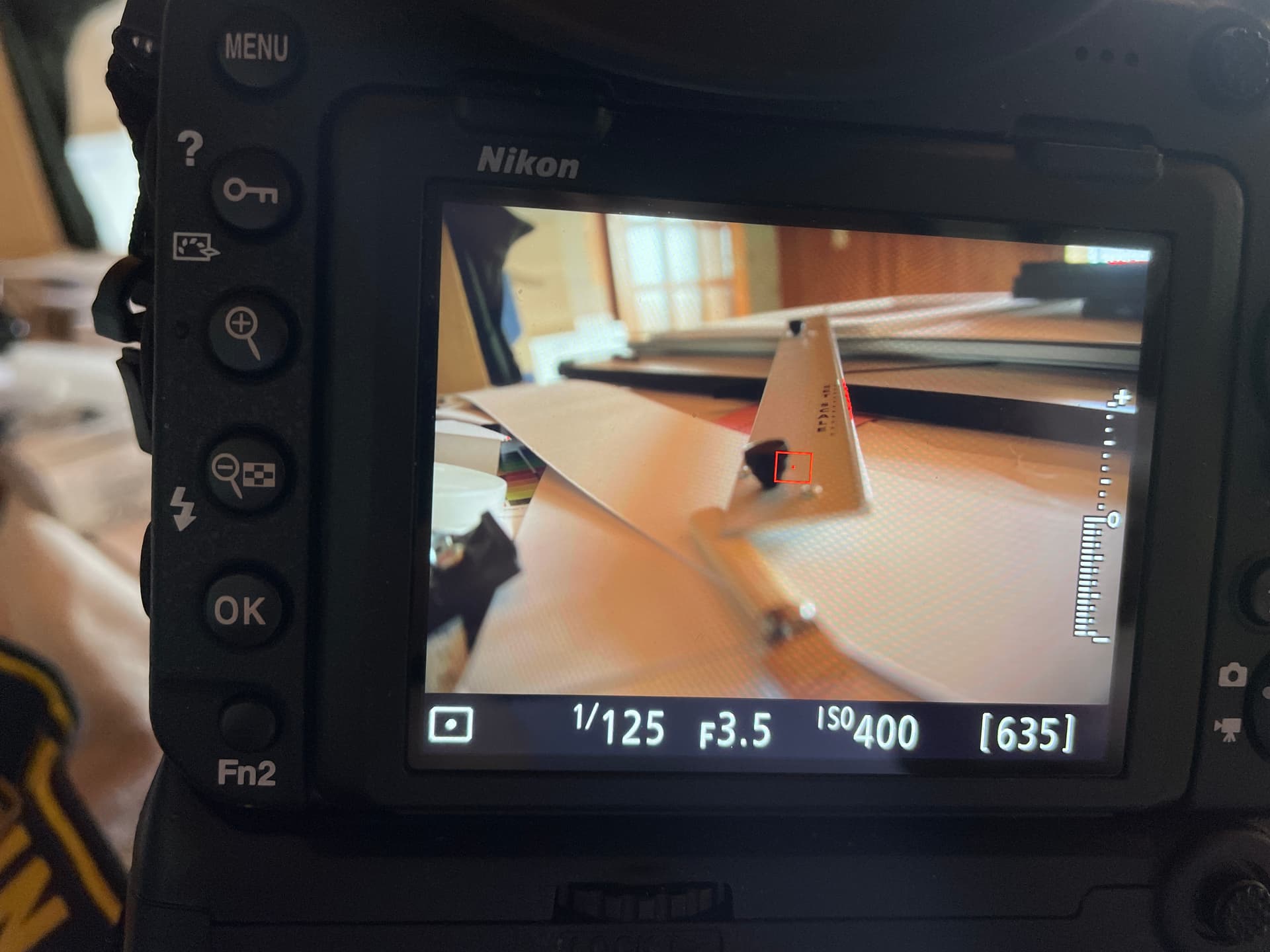
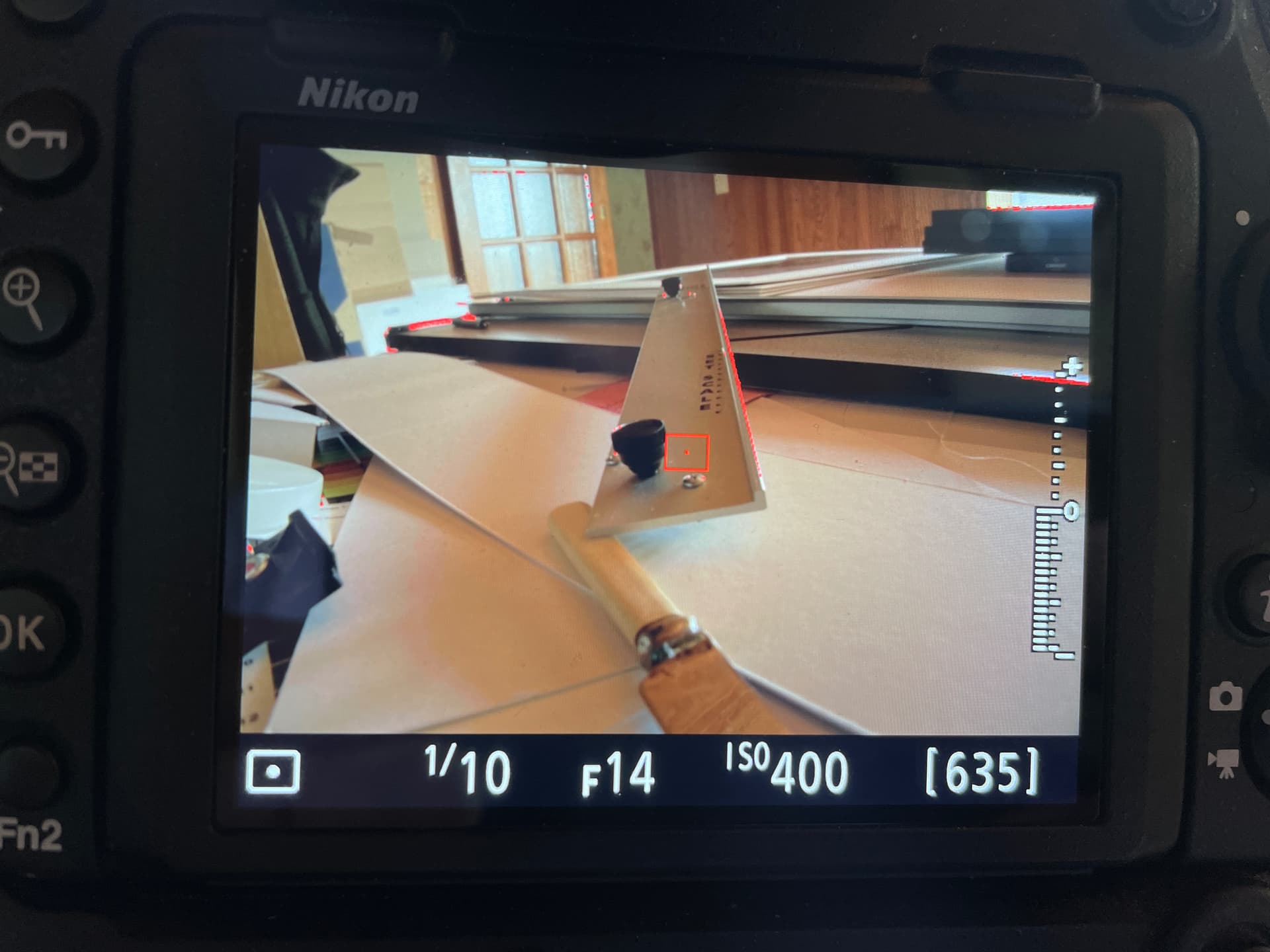
You did know that your D780 has “focus peaking” in LiveView, that allows you to see which parts of the image are truly in focus? If not, I would suggest you try it out.
As you can see, this first shot is taken at f/3.5 and the red line on the edge of the ruler is quite short, because that is all that is in sharp focus at that aperture.
This second shot, taken at f/14 shows a lot longer line, denoting the extended DoF available at the smaller aperture.
Go out with your tripod and setup so that you can see something static that is vaguely bird-shaped and sized, then set your camera and lens to MF and, in LiveView, you will see the red markers on whatever is in focus as you turn the focus ring… Adjust the focal length, aperture and focusing distance to see what differences they make.
Yes, it’s like going back to school. No, you won’t get stunning, or even mediocre images. But you will get the hang of what you need to adjust in order to get your birds in focus without sharpening the background.
Warning!!! You might not like my idea but, until you are prepared to do this exercise, I think I, for one, might have to stop responding to your posts about birds.
The red square turns green if the AF is working but these shots were taken in MF, where that square is ignored. I usually leave it in the centre of the frame because I very rarely use AF in LiveView. I use Nikon’s tethering app with the focus peaking on the computer screen - so much easier than the tiny rear screen on the camera.
If I was wealthy, I’d already own a Z9 and the better Nikon lenses.
If I was wealthy, I’d probably be driving an Aston Martin, or a Bentley.
When and if I win the lottery, we can discuss this, assuming I ever start to buy lottery tickets - which I’ve never done.
The reality however is that in the highly unlikely chance I become wealthy, I would be using the same photo gear as I use now, along with a new long focus lens.
I never wrote that, or implied it. That’s your scenario, not mine. I learned those basics a lifetime ago, and the photos of birds with a blurry butt are on purpose, for the very reasons you refer to. I used the settings I felt were the best compromise.
Of course, and obviously, my photos are “random” as you define it.
Random is better than being stuck in a rut. It’s also a benefit of being retired. I can do what I want to do, at any time I select (within reason). There’s also a “learning curve”, which means trying lots of things, and selecting what is most appropriate. Being retired means I can mostly do whatever I want to do, whenever I want to do it, and I’ve learned from experience that photographing birds over Biscayne Bay is a waste of time.
I don’t remember your posting any of your own photos (processed in PhotoLab). Maybe I missed them. Anybody can write stuff here, but very few people back their words with photos they have captured, and both explain and show what they have done. The photos I post come from PL6.
Go look at Steve’s BCG forum, and you’ll see what I want to do.
Been there, done that, and that is not what I am currently trying to learn how to do, which I’ve already posted.
Yes, but that is not what I’m currently working on. Thanks for describing all that. Everything in time.
I appreciate the effort, but for me, it is one thing at a time. For right now, I simply want to capture images from the D780 using Live View, similar to what I can already do in DSLR mode. Some people here are telling me it’s not possible. Others think it is “trivial”.
Focus peaking? I read about that, but trying it on the D780 in Live View comes after I learn other things.
When it comes to learning Live View (ML mode) on the D780, I’m still in what feels like the first grade. Oh well, I’ve been through that many times, and eventually things start to make sense.
You’ve got to stop calling it that. As I and others have said before, the camera doesn’t have a “mirrorless” mode. It has LiveView and, in LiveView, you have access to auto-focus and auto-exposure technology that originated in a true mirrorless camera.
Personally, I wouldn’t dare be seen using my camera in LiveView for anything other than studio work or, maybe, covert street photography, where I don’t want the subject to know they are being photographed (the equivalent of a medium format camera with a waist-level finder)
My main question - while I wanted a “sharp bird” in front of a “blurred background”, anything I might have done to make the back of the bird sharper would have done the same for the grass and stuff.
If you understood how to control DOF in your camera you wouldn’t post these questions/comments
Post 1042
In my first photography class, I failed. I re-took the class, doing things their way, not my way, and aced it.
Looks like you are determined to repeat that first experience. What’s that old cliche’ about doing the same thing over and over expecting a different result…
And there’s the comments that you like to “re-act” or “go with the flow”. Another old cliche’ comes to mind - Fail to prepare means prepare to fail.
Is this Steve Perry’s approach to photography?
If you don’t really want to plan your shot than switch your camera mode to “A”. That’s what it is there for.
Sigh, have it your way. I know how to control DoF, but this photo below is exactly what I wanted to capture, just the way it is shown below. Everyone in this forum thinks it’s a mistake, but the bird photographers in Steve’s forum like it this way, and more importantly understand why I shot it this way. In fact, some of them posted links to their own photos done this way with similar out of focus “tail ends” deliberately. I captured what I wanted to capture, the way I wanted to capture it. All the mud on the bird’s beak added to the effect. People’s attention is directed at the bird’s head, and beak, along with the feet. I like the photo, and the people in BCG like the photo, and understand my reasoning. I also like that with PhotoLab, I was able to “enhance it” the way I did. Had I changed the DoF to have the whole bird sharp, would have prevented me from getting what I was after. I do appreciate all the help and feedback I get in this forum, but in my opinion, “fixing” the DoF issue would have ruined what I was after. When I look at this photo, as it is now, my eye goes right to the bird’s eye/head/beak, and the DoF along with the tree helps achieve this.
Perhaps next time, I’ll take two photos, one done this way, and one done as @Joanna suggests.
I’m no Ansel Adams, but I am an Ansel Adams fan. Sometimes he captured images as you suggest, and other times he came upon an image with no time to prepare, just barely enough to capture one image. In his mind, he knew what he wanted, even if it’s not visible in a contact sheet - but he SAW something, and worked rapidly to capture it before it was gone.
I saw this bird photo and immediately captured it as you see it here. Fifteen seconds later it was all over. There was only enough time to “do”, not enough time to “think”. Raise camera, focus, compose, shoot, shoot again.
If you ever decide to capture photos like these, you’ll quickly understand. Maybe take a little time and check out Steve’s forum, or any of the “birding” forums. Every time I do that, I realize how little I know. And I realize I am a total beginner at this, and how little I know about birds… Fortunately, I know some good people who are helping me with real advice, suggestions, settings, and so on.
Been photographing birds for more than a decade. As stated above, I’ve had the pleasure to bird/photo with, and learn from, National Geographic photographers and many other excellent photographers. Steve Perry at BCG is also a “good” photographer if you like his style. He also mentions some good points about preparation, visualizing the shot, recognizing when/what type shots are possible in some situations. But you seem determined to do it your way just like your Photography class years ago.
I came to Photolab because their denoising routines “saved” many a high-iso photo. Other posters have been very helpful with processing techniques to help me learn more about Photolab.


 SHUT UP! Go and take sharp images instead of wasting our time with your hyperstuppirn posts!
  Do you really want to be called a dumb old fool?