This morning I installed the free try out version of Photolab 8.
Importing Nikon RAW-images, some edit operations and exporting as a DNG-file worked well, but not the cropping tool.
Before I used to crop JPG-files in a very old and simple Picture manager program of Office 2010, shown in file 1, by specifying the number of pixels for moving crop handles at the top-, right-, bottom- and left-side of an image, as shown in attachment 1.
But I cann’t find the way how to do this in Photolab 1, starting from the palette for cropping (I cann’t show this position in DXO PL because as a new user I’m only allowed to attach one file).
Is this a missing feature or am I missing the right buttons to do it?
While you cannot enter specific number of pixels of a crop, you can use the pixel dimensions to define the appropriate crop ratio. You can then use that ratio and observe the figures while you crop.
If you e.g want a crop to precisely 1234 by 5678 pixels, define this as a custom ratio in the toolbar below the preview and drag the crop corners until you get what you want. Note that you might need to move more than one corner in order to match the exact numbers.
Thanks @ PieloePascal.
For me the horizon-function is like the rotate-function in other software, and its logical for me that crop and horizon/rotate are two separate functions.
I used to start selecting my object in RAW-mode, sometimes at pixel level. One of my first experiences with DXO photolab was the annoying black field in the bottom right corner for displaying the numbers of pixels (there was a very small detail there at the corner of the image that I wanted to keep).
@ platypus
Thanks.
I consider your advise as a workaround. So, what I prefer is not available now in DXO PL. So, go on by searching for it does not make sense. Clear.
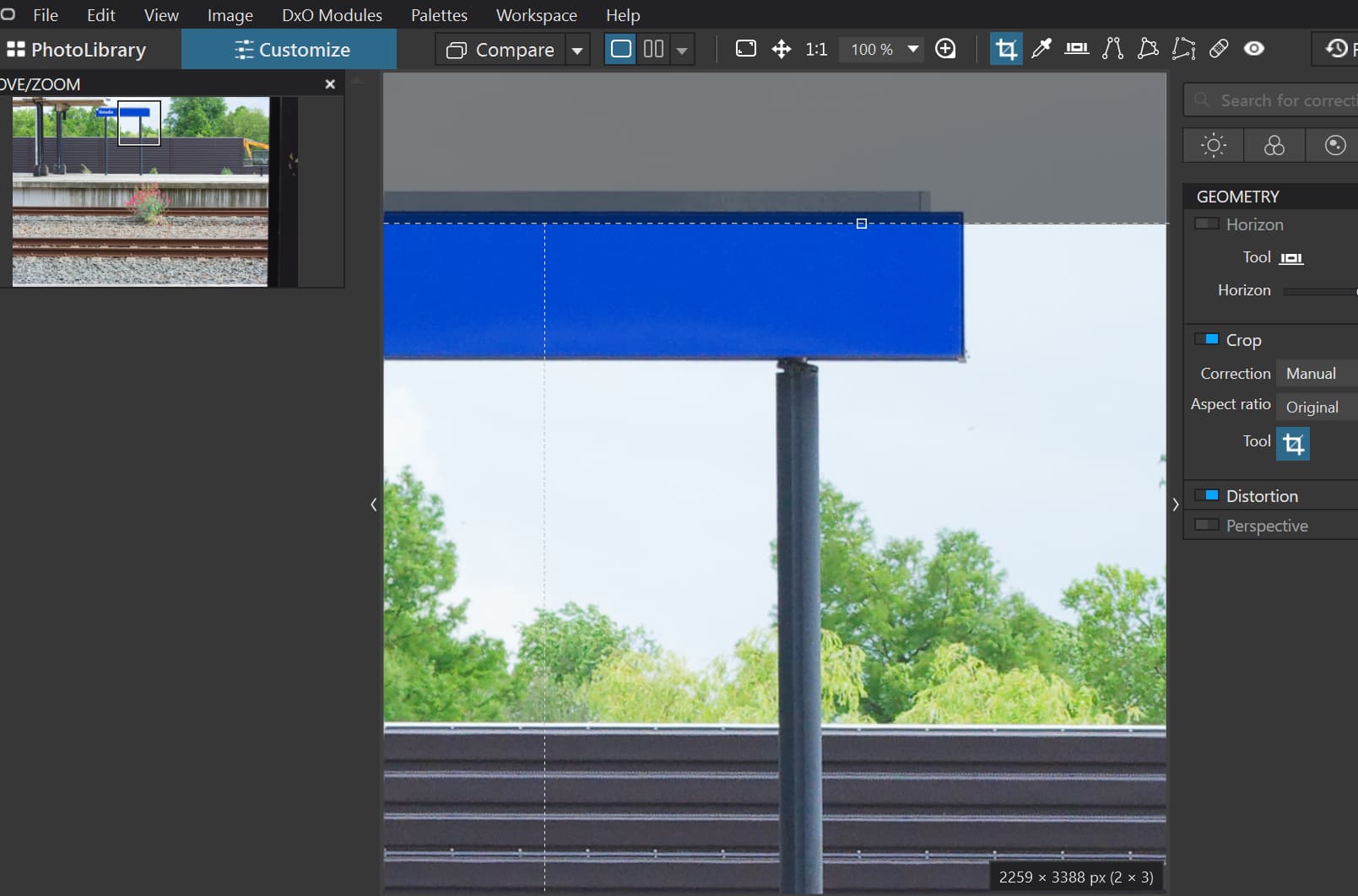
I tried different things and discovered: cropping pixel by pixel at the edge of a desired selection of an image is possible by using the move/zoom tool in combination with the crop tool, as you can see in the attachment.
The crop is done without decompressing, cropping and then recompressing the JPG. I.e. no loss of quality due to multiple decompress/recompressing cycles .
The crop is done without decompressing, cropping and then recompressing the JPG.
Cropping is done on the in memory raster image. A jpg doesn’t have a raster structure, it needs to be decompressed and loaded in memory to obtain that raster structure. Then you can crop, doing further edits or save it again as jpg, which is by definition lossy.
I also don’t know how one can recompress a jpg. You’ve to decompress it first and then compress it again. And every time losing quality.
I googled for that function, no answer here.
This is what happens as I think.
Jpg is builded with blocks of pixels. It is decompressed and loaded in memory so you can make the crop. When saving that crop it selects those blocks from the original image that covers the crop and modify the jpg according to that.
That would mean no edits are allowed, nor before nor after the crop. The crop size is always a multiple of the jpg blocks.
JPEG compression involves grouping together neighboring pixels according to the same description (RGB).
There is no decompression upon opening.
All (number of) pixels are displayed but neighboring pixels (with the same description) will be identical (sometimes giving this porrige effect).
If cropping occurs, the image area (one of the calculation factors) is revised.
The image loses quality, especially with a high compression rate.
And from what I understood is that lossless cropping is using these blocks for a new image. Decompressing and opening the image just for visual purpose to crop and then building a new jpg with the old blocks. So no edits possible and the crop size is determined by the blocks.
If so it’s impossible to specify the number of pixels.
You take an image, you crop it. If you want lossless, you don’t compress it when you save it, it you don’t mind quality loss, then you compress it when you save it. It’s that simple.
Compression doesn’t lose pixel size, just quality.
Saving as jpg always compresses, by definition, even at 100%. And this is about cropping existing jpg’s.
It wouldn’t be a problem when saving as lossless tiff by example.