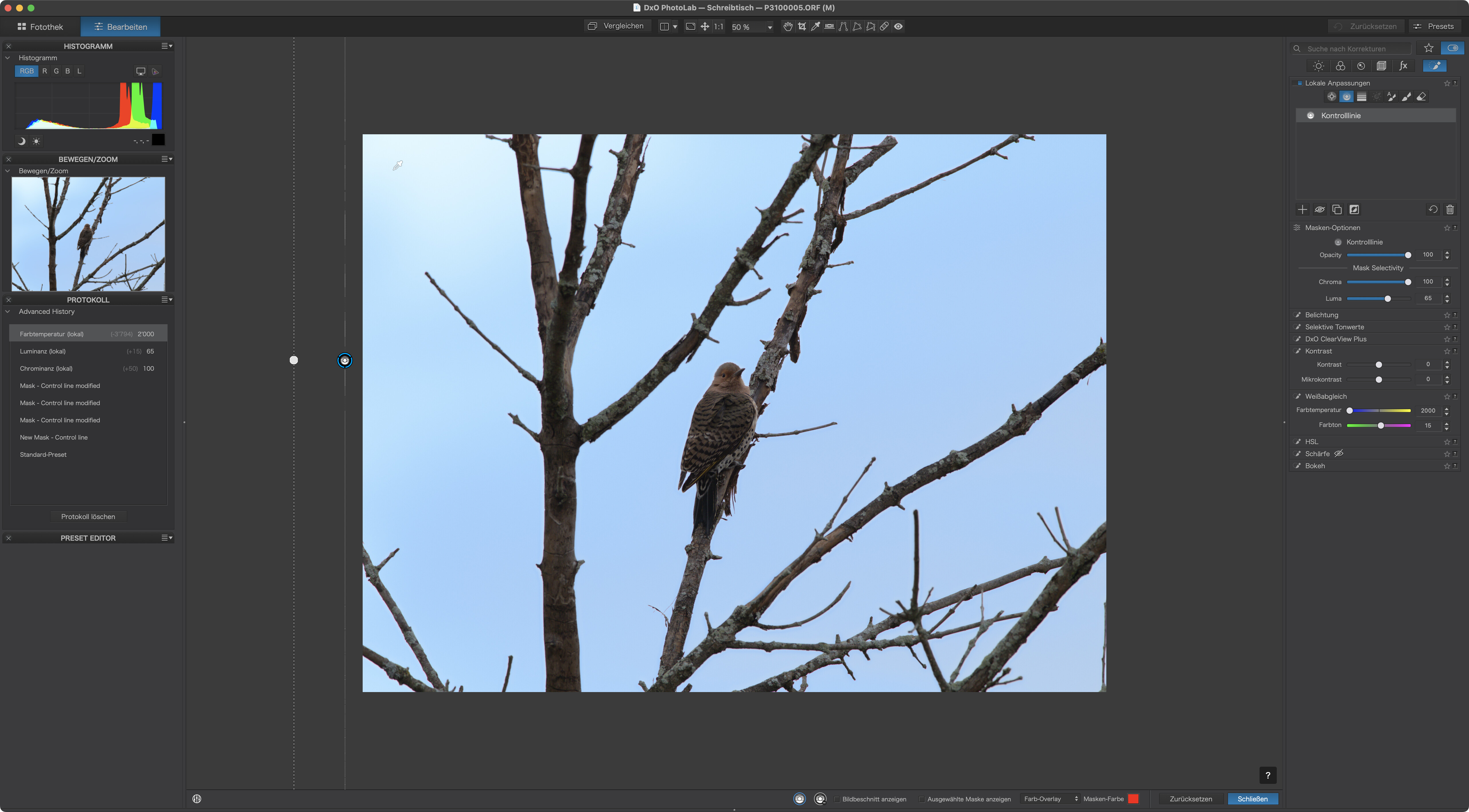
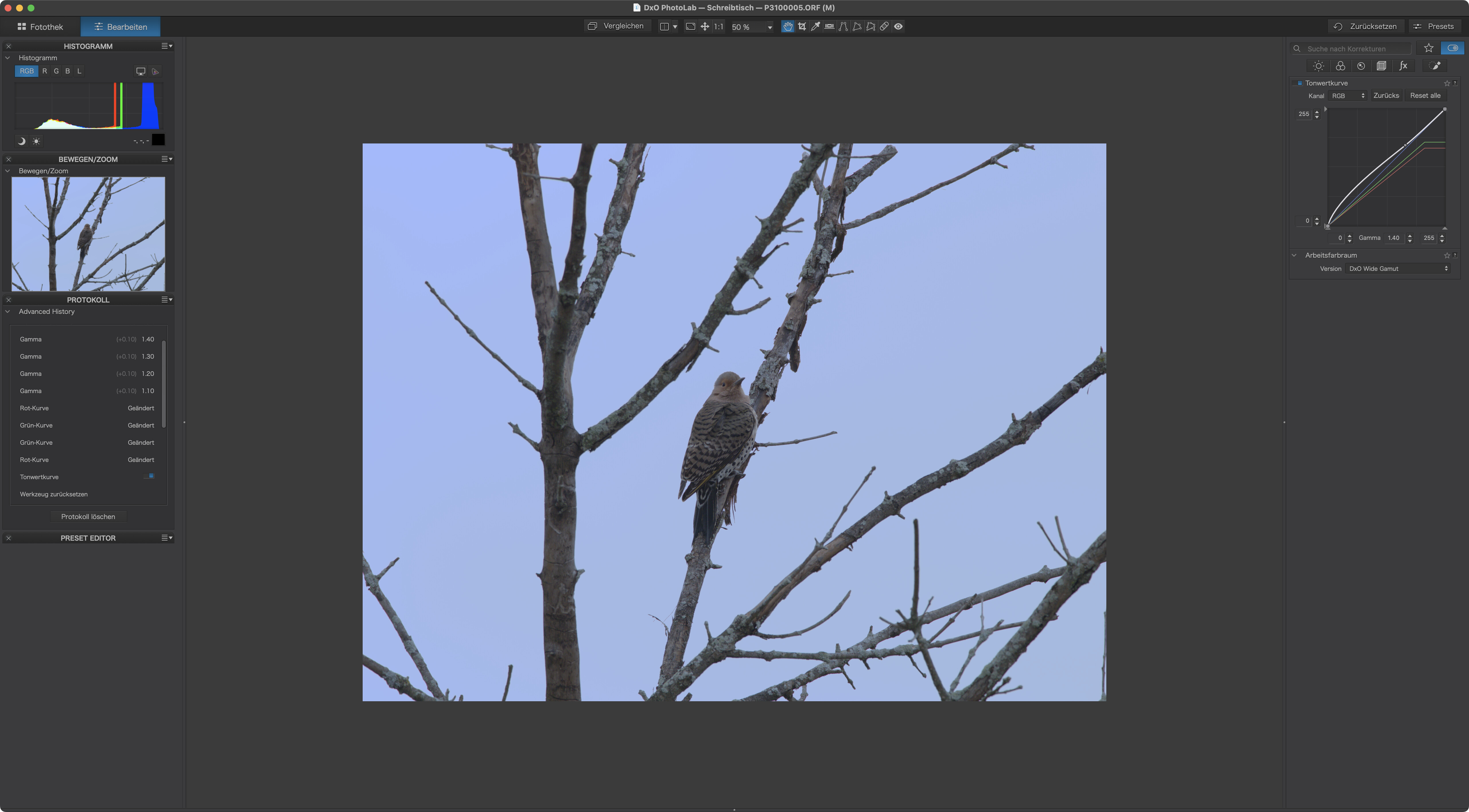
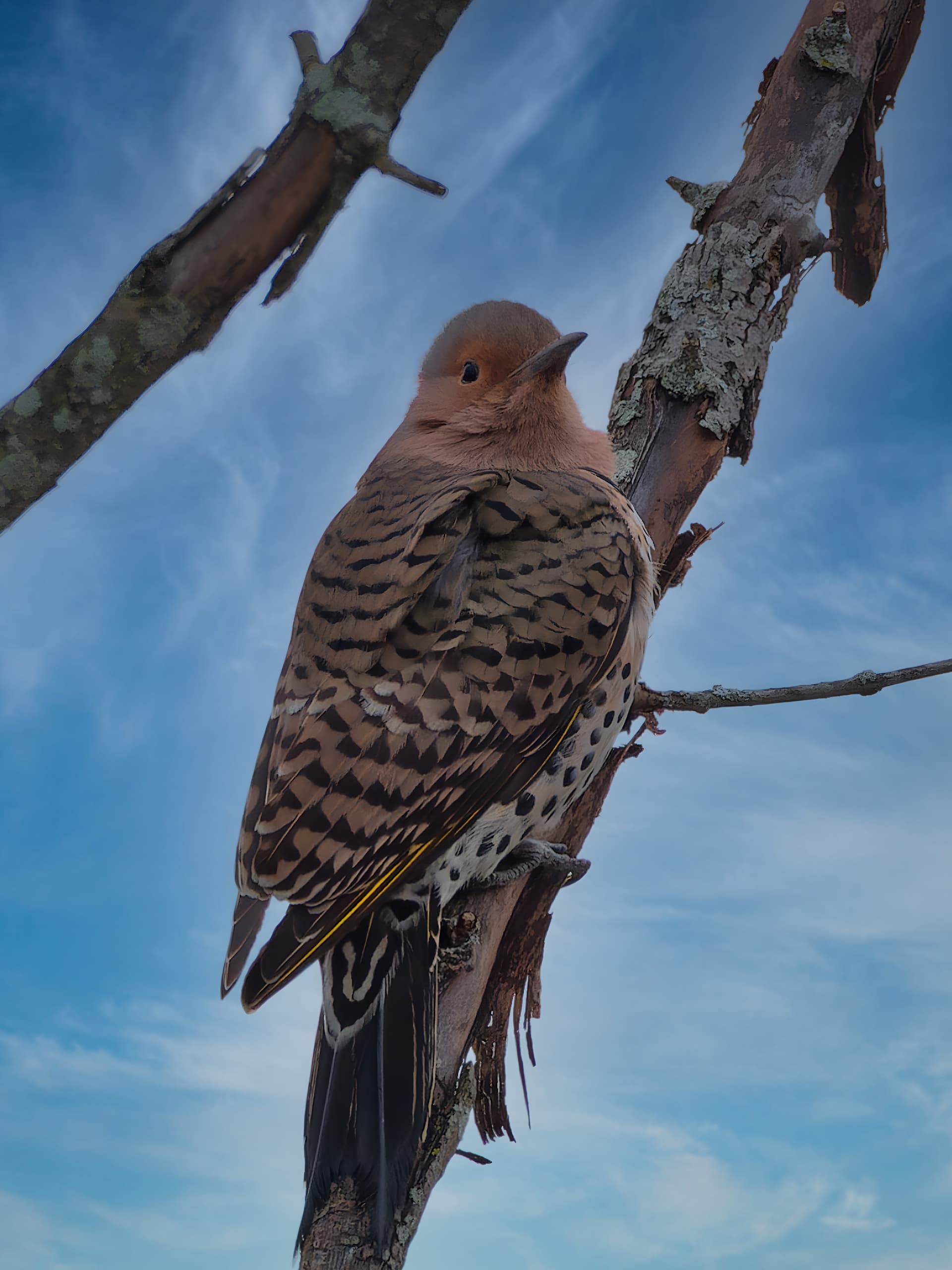
If for no other reason than to try to have done it your way, I will do as you suggest.
There are two problems to my way of thinking:
This bothers me for my application, as the sky in my photo was/is already blue. Because of my exposure, it got burnt out and looked white/gray.
What I am thinking - I already took a picture of the bird against a blue sky, so why am I going to all this trouble to create what will look like a blue sky, that doesn’t look as good as the blue sky I already photographed?
My preference is my blue sky I already captured in my photo (with the exposure adjusted), including the clouds that I thought/expected would show up more prominently.
Nobody else seems to mind, so maybe it doesn’t matter, and I’m the one who is confused, but I’m feeling that I’m replacing my sky, which is fine for others, but not fine for me. I will do what you suggested, if for no other reason than to re-learn how to do those things, but I will forever have those negative thoughts about what I did. I suspect @Joanna would find a way to bring out both the sky and the bird, with the correct exposure for each. I’m not that smart.
No doubt, there are different ways to get to Rome … and if you want to lighten the bird
(by a touch to remain believable in a backlit situation) you need to add something
(CL, CP, Automask … whatever gets you there).
The camera captures a RAW file, that must be interpreted / decoded by software. So, a different color tone, saturation and how light it will be in the final photo is to a large degree open for your taste.
This was very interesting for me to read. I’ve seen some issues. I liked the sky replacement better than most attempts to transform an overcast gray sky into an overcast blue one. Which is not working as there’s simply no blue haze in "real life. So, separating the main subject and replace the less important part of the background by another background works in my eyes (and to my light disliking, as I’m not a fan of sky replacements) better than “keeping the whole picture and modify a part of it”. Sorry, the results were not very convincing and I don’t see a reason why a “quick and dirty” approach of an experienced user could be improved by spending more time, “slow and clean” so to say.
A hazy sky cannot be fully cleared of the haze - and colouring the haze makes it very quickly unbelievable. Additionally, on one of the edits of @rrblint there was a strong halo around branches and parts of the bird. Things like that are an indication of manipulation.
With the sky replacement of @Louie there was a slight disproportion of the qualities of light and the bokeh relation. the clouds were too sharp. That was another indication of manipulation. As well as the too sharp mask of the bird. Traces of masking were often visible. and the bird itself remained lit by a hazy sky.
Also, there was the question along the line “is a photograph with replaced sky part still a photograph?”. I would call it a compositing. But I ask “is a photograph with a strongly colored sky still a photograph?” All of you had to alter something and the situation at the moment of taking the shot was already difficult and hazy in the background. Now, which manipulation does hurt most or is very obvious?
the moment that shows a section/situation of a “dynamic process"
the focal length selection
the decision of what to include/exclude from the photo
…
I try stay away from fruitless (and often overheated) discussion about whether a photo can be manipulated … and also whether it’s worth doing so.
After all, this is about a raw file developer & editor and not to deliver out-of-camera jpegs.
So for me, the interesting question is, what do we perceive?
In fact, we quickly scan our surroundings (initially attracted by high contrast, signal color, movement…) “piece by piece” at an angle where we can see clearly and the eye can capture a large dynamic range. … We put all of these impressions together into an “image” that is influenced by what we expect or want to see, what we have learned to see. While we receive a lot of information, we perceive selectively.
Then, do we want to implement this “image”? What do we want to convey?
In both given cases with the bird in the tree or the pelican in the air the sky is more or less gray and the initial question was how to color/tint it.
I think good guidance is to remain credible. While this assessment will likely vary depending on the person, the retouching/correction should not at all be noticeable to another viewer.
Both examples show too much cropping, resulting in too low a resolution. – In the case of the bird in the tree, the backlight encouraged edge bleeding, which is better to fix with a graphics editor. And the PL lens profile ‘degrading’ the bokeh along the trunk made it difficult to seamlessly tone the background. – And the pelican lacks details.
I was simply trying to use @Wolfgang 's technique to answer the OP’s question of “Need help recovering blue sky…”. While not specifically stated, I took that to mean “in Photolab only”. I don’t mind sky-swaps or bluing ,and I don’t care what it is called, photograph or composite. I’m not as picky about semantics as you guys are. as Wolfgang wrote:
I completely agree!
Stenis
(Sten-Åke Sändh (Sony, Win 11, PL 6, CO 16, PM Plus 6, XnView))
69
Don´t apologize for seeing the world through som sort of documentary or photojournalist lenses or filters. Today that stance is more important and justified than many times before. The “truth and authentic” is definitely under attack these days. Just open Youtube and search for info about some of the ongoing wars if you doubt that :-). It is nothing wrong either to try to get as much of a picture sharp either because that might be the most natural way to do it most of the times in a documentary context. How to do it is really a matter of what we want to express or not. Sometimes we chose one way and next time in another context the other.
There are rules around image manipulation both at news agencies, in photo forums and in competitions as well at photo clubs and in many other contexts like the photo centric sites site in in many countries. Many of these rules overlap or are identical but there are discissions busting out from time to time which can be seen as sort of anti-theses to the current believes and rules. AI is definitely trigging this but also changes in philosophies and even in semantics.
In the forum I use to attend in my country there was a long definition about what was OK to do or not to do around the concept of “Manipulated picture”. The word “Manipulerad” or “Manipulated” in English" was of some seen as a concept to negatively loaded to use since it also is a commonly used word in other contexts.
Today I think the discussion has landed in the use of the concept of “Purely documentary image” instead. So, if I am going to update myself, I will never say anything else if my pictures are postprocessed than you have to consider them as postprocessed and just that fact is just enough not to trust them “for pictures looking exactly as I saw them through my lens” when taking te picture. Despite I usually really try to not making anything else of my “documentary images” then I saw I can never guarantee I break a rule or five just by pulling a little more in some of the controls of my RAW-converter.
I don´t think non intentional manipulation in practice is not necessarily about something binary to or from, but much more about a treacherous sloping plane where you are not always even yourself aware that you have gone too far according to this restrictive often very high-resolution set of regulations. In practise it is just about pulling a little too much or hard in some of all those controls of your RAW converter. This is my way of staying away from overheating discussions around the concept of “Manipulated” which I really never have fully understood.
This morning, I went on what I call a “walkabout” deliberately taking my 2007 Nikon D3. I kept thinking of “goals”, and was constantly changing my mind. I decided to walk by a local Yacht Club, with zillions and zillions of dollars of expensive yacht tied up. First photo was of two of those yachts, and as I kept walking, my mind was becoming fascinated with all the shapes and colors of all these boats tied up next to each other. As a photojournalist, I suppose I ought to have worked on a photo of one, or more, boats, but my brain was getting distorted and contorted by all the bits and pieces of boats overlapping over each other. I consider that as an “artistic” photo, trying to see things the way I learned from @Joanna. I didn’t see a “story”, just a collage of bits and pieces of boats. I didn’t really even consider what was in the photo, I was so busy moving my camera up, down, left, right, just seeing shapes and colors.
I expect @Joanna to point out how much better the photo would have been had I used my D780. I also wondered how the image from either camera would look in B&W. I felt like a composer, as I was including/excluding shapes, and re-positioning the camera until some mysterious part of my brain was content with what I thought I captured.
I continued on my journey, food shopping, got home, and figured out a way to get the new images on a CF card into my computer. To me, PhotoLab usually becomes an extension of my mind, allowing me to manipulate the image until it looked like what I wanted to show. It’s posted now in the off-topic thread, and as I always try to do, the original RAW file is there, and the .dop file to show what I did. I like doing that, as it allows other people here to show me how I could have used PhotoLab differently to get what might be a better result.
I screw up far too often. The discussion of how to change a sky color was helpful, and included things I wasn’t aware of. My comment on complaining about painting in a new sky was out of place. With second sight, I’m aware of this now. We’ve all got opinions (but nothing is “equal” and some people’s opinions I find far more useful over time).
One last thing - for me, photography is for enjoyment, for fun, to express myself. Most of my old cameras I want to forget about, but a few of them give wonderful memories from the past, and even if it’s a silly idea, I find myself wanting to use them again. I also want to go back to capturing images in B&W, and one of these days, I’ll get around to it.
A question about this - do we react to what we actually SAW with our eyes, or to what we felt as we saw it?
Long ago, I never considered the second possibility. Nowadays, I’m likely to deal with what I “felt” more so than with what I actually “saw”.
which is a problem, as nobody viewing the image can/will be aware of what I felt, only with what I captured in my image. There is only one person in this forum that I think will be able to understand what I’m trying to say here…because she seems to have a great ability to see through to what I was trying to do, even if I messed it up.
Then I suggest you try to write one post in Spanish, German or French and see how far you come without being picky in semantics In a forum with a lot of non-native speakers, the native speakers should always be aware of context. “wheel” can mean a lot of things… and “recovering” as well.
Don’t want to talk for others, but I really try to be more careful with words in a foreign language, especially in a screen-to-screen instead of face-to-face situation. But I’m also depending on translation tools, and no matter how developed the AI is behind of it, the results get better with more context as well.
I also downloaded the RAW of the thread opener @bkspero and I could not detect any blue sky to “recover”. At this time of the day and season gray sky is normal. So – semantics again – if there’s nothing to recover. the thread title asked the wrong question. How about “how can I get more blue sky?”?
There are many helpful suggestions for using PL7 to “fix” the sky color.
I admit, I am lazy. I hope you don’t mind but I did the follwing (took 3 minutes)
Ran image through the Upscayl app to increase apparent resolution.
Used Luminar Neo to replace sky and some minor adjustments.
There are many things PL7 is great at, but it cannot do evertything and that is why you might consider having more than one app. Now, I guess you could use something like Photoshop or Affinity Photo to get a jack-of -all-trades app but even then it might not satisfy all needs.
Just to make sure, to @Joanna and @Wolfgang, does this file contain both of your edits, as VC files?
Just to make sure, as it has the “vertical bar” in it, which I thought Windows would not accept?
That’s my plan for tomorrow, to see, and understand what both of you did, and then try to replicate what Wolfgang illustrated up above.
My two pennies worth if I may. I would suggest that when photographing into the sky a polor filter is used as this will help retain some of the blue and then when processing the picture getting the blue back will be a lot simpler. Use a central spot light focus to keep the bird from getting too dark and you will get a lot more data to work with that requires minimal manipulation.
As somebody that loves bird photography this is somethinmg I learned a long time ago. Made a big difference when you get the base picture right.
I’ve made numerous posts in languages other than English with the help of Deep-L(a very good translator) but you are correct in that context is very important. I’ve not had any misunderstanding or complaints about any of these posts. I can’t make the same claim of posts in English.
I leave that as it is. Just keep in mind, sometimes we need to guess a bit “What could this person have meant right now?” and not always we ask back to clarify.
Now, statistically spoken: how many post in English here? How many in their native language if this is not English? 1%? 3%? So, given that misunderstandings can be caused by the sender (for not being clear) or the receiver (for not getting the message), it’s safe to assume that people writing and reading (not talking, that’s a big gap in between) in foreign languages will have a couple more opportunities for misunderstandings, no?
That’s what I typed. Now let’s see what DeepL made out of it by just translating it into German and then back into English (US):
Well, statistically speaking: How many post here in English? How many in their native language if it’s not English? 1%? 3%? So, assuming that misunderstandings can be caused by the sender (not being clear) or the receiver (not understanding the message), you can assume that people who write and read in a foreign language (not speak, that’s a big gap in between) have a few more opportunities for misunderstanding, right?
Some details are different. But I could not judge “better” or “worse”, as I’m no native speaker.
Good point, but your example gives me more confidence in DeepL. You double translated what you wrote into German and that then translated into English and it is nearly word-for-word identical with little chance of misunderstandings.
Absolutely! I’m a big fan of DeepL for the languages I need to translate into or from. Google appears to be better in Asian languages, I once read. But that might be different today.
What also comes in mind: like this forum there are so much more places to exchange opinions, help, suggestions… and a lot of them are in English. So sometimes I write phrases or words I read somewhere else without double-checking them. This behaviour of most of us also will alter languages. Plus the aid of translation software, plus AI. Learning a new language is life long, never finished, from the moment I had a pen-friend in New-Zealand and 35 years later I’m still learning.
This is very true, besides learning new words, tenses and all the grammar rules, one needs to learn idioms and colloquialisms and some of these vary from region to region.


 In a forum with a lot of non-native speakers, the native speakers should always be aware of context. “wheel” can mean a lot of things… and “recovering” as well.