Editing high dynamic range images in PhotoLab 5

Mike, I learned a long time ago to not blindly adopt others’ opinions as my own and then close my mind on the subject. My preferences and perceptions are my own and my own only, and what other people say is colored by their own personal preferences and their own personal perceptions. That goes both for those who criticize and for those who praise. An open mind is a mind that will learn and expand; a closed mind will eventually stagnate.

Mirrorless technology is a huge paradigm shift. It’s a big challenge to leave the comfortable confines of an existing technology for one that’s so different. I started playing with photography back in the days when the Nikon F ruled the world so I’ve watched the progression of camera technology. Mirrorless technology is not just the trendy novelty of the day, it is now a huge success and is rapidly supplanting DSLR technology in many areas because it is getting so good and offers so many meaningful advantages.

With so much press on mirrorless out there, my curiosity about mirrorless finally reached a point that I had to try it for myself. Did it improve my photo-taking skills?? … yes. It does nothing at all for my “skill” in “seeing” and composing pictures but it does help me greatly in getting more photos that are more consistently focused, whether static or action, and better exposed. What you see in the viewscreen is exactly what the focusing and exposure systems see. Not so for DSLRs, and that is a meaningful difference.

Mirrorless technology is improving so rapidly that what may be true for a camera you buy today may not be true for a camera you can buy 6 months from now. Some of the criticisms out there about mirrorless arise from older technology and, in truth, may be more academic than practical anyway. It’s prudent to investigate for yourself, in depth and from all angles, and look for the very latest information.

Only you can decide what is and is not good for YOU and the only way you can do that is to try it. You are curious so why not see for yourself? I’ll never go back to DSLRs because, for me, their positives far outweigh their negatives (sometimes puns can be so fun).

As you know, I think otherwise and would ask if the EVF can give a clear easy to focus image in very low light situations when You need to shoot long exposures at low ISO?

I just shot a still life yesterday in subdued studio lighting, in order to not get flare off reflective surfaces. Even though the Nikon D850 has focus peaking, I was obliged to temporarily raise the ISO enough to get the focusing system to register.

Unfortunately, unless I can find someone willing to lend me a Z series to try out in similar circumstances, I’ll stick to a camera where I can still see the world directly through a good old OVF :grinning_face_with_smiling_eyes:

There all nice images as many bird shots they are time freezemoments. Most of the time you can’t compose the scene as you want. Sunlight direction, shooting angle, shuttertime aperture, stuff behind and in front the bird, every time you solved one the other sticks his head around the corner. Or the bird moves to an even more difficult spot…:roll_eyes::zipper_mouth_face:

One thing i learned is mostly fill the frame with “animal” but don’t forget to zoom out and in wile your shooting. (less and more surrounding)
Often is the picture with less bird but more “show of the moment” and your initial view much more to your liking then a cropped full filled bird. (they acted as pairs, you need bird detail and the habitat in order to tell the story.

I don’t critise you efforts or have a opinion about your shots which you must see as rules or guidelines, there are as they are. Time freeze moments.
I talked about things i bumb in during and in post selecting birdshots. Mistakes, lucky shots, rather good shots, and geesh how dumb could i be? Shots.
A bird can be a ornament and the scenery the subject and vise versa.
That’s my experience atleast. :grinning:

Have fun.

Ed, it’s about the photo of Mike’s crane, not about DSLR vs Mirrorless. – The only real difference is, he could take many photos with a ‘quiet’ shutter and his manual 50mm lens, while with a DSLR and loud(er) shuttersound he would have to use a longer focal range to keep further away …

A cam is no more than a tool and one should use the one, one feels comfortable with to get the right shot – which includes proper technic et all.

@mikemyers

Mike, the photo of the cranes you started with can show both sides of the medal, but you should make it clear to the viewer

  • if it’s the pond and surroundings your beloved bro put up, which now even houses cranes
    (thing is, You know it, but the viewer doesn’t – so you have to showcase …)

  • or the beautiful Sand Hill crane
    (and to exhibit the bird you don’t enhance contrast & colour of the ‘backdrop’).

To avoid any misunderstanding(s), it’s Your pic and You decide what and how you present it – simply make use of the ‘right’ side of the medal.

Indeed, all your explanation about how you took the photos …

I couldn’t put that better together.

Again, this is not to criticize your efforts, but to help you in finding the ‘right’ way of presentation.
The viewer doesn’t know your intentions / feelings and can only grab something from your single pic
– as long you present it without context.
And still, the viewer will have his/her own interpretation – but isn’t that a good thing?

Well, I spent the previous week going round and round on his property, taking “regular” images and probably 50 with infrared, that I hadn’t yet processed, (which I may “develop” in the next few days. When I got down on the ground, I dragged myself right and left, to include the orange/brown tree that was in the process of changing colors, and to get the weeds more off to one side. But you are correct, once I had the background like I wanted, I totally concentrated on the birds. The pond and its surroundings was already set up, and I stayed in that one place, except for when I moved to the left to shoot the smaller bird that I captured cleaning its feathers.

I’m usually aware of the background in my photos, and move around until it looks the best that I can get it - when I have time, and can. This is especially true if I’m using a tripod.

I can accept that it is a what am I meant to be looking at image. When I look at the photos myself, I look at both the bird and the background, but I give the most attention to the bird.

  • If I sent @Wolfgang 's photo, or your photo, to my brother and other family members, I think they would notice two things - the bird, and a dull image of a tree was changing colors.

  • My brother would see the bird in front of HIS beautiful landscape.

  • Others would see the bird, and not pay as much attention to the landscape.

  • You and @Wolfgang would see a bird.

  • Me? I see both a hopefully good capture of the bird, and also everything else, the “landscape”

I’m left now thinking you and Wolfgang are technically correct, but I still prefer the photos as I edited them. …but WITH the change that Wolfgang made with the masking.

If I was at a zoo, taking this photo, I would agree with you and @Wolfgang and concentrate on bird, not background. I guess this is a special case for me.

I wouldn’t argue with anything you wrote, but in as long as I can remember, every time I’ve used a mirrorless camera that didn’t also have an optical viewfinder, I very much dis-liked it. My Fuji X100f and my Leicas all have optical viewfinders, and in the case of the Fuji, they also have digital. My Canon G7X Pro Mk II lacks any optical viewfinder, and that bothers me. I only use it in India, because it is small and goes on my belt pouch.

I see so many benefits of using a mirrorless camera, but two major issues for me. First, I suspect I’ll never like the digital viewfinders, until/unless they look more like optical. Second, it takes time to “scan” an image on the sensor to read all the pixels, but on a DSLR that’s done at once. People have been complaining about this. Since I don’t see my switching to another brand, that leaves me with a choice of a D750, a Df, and a Z. Until one of the Z camera gets good enough that @Joanna approves, while I’ll certainly check one out at the first opportunity, I don’t plan on buying one.

If I want to check out the technology, I suppose I could buy one of these for “only” $1000…
Nikon Z fc with 16-50 lens
Curious - why do YOU prefer the mirrorless?

Gee, you described exactly what all the things are that ought to be considered. Had I brought my D750, with a zoom, this would have been easy. As it was, I had the Leica with one lens. I don’t plan to use the Leica again in the future for bird photos, and I would prefer that any camera I might use would have good autofocus.

For future photos, without “personal meanings”, I will do exactly as suggested up above. I agree with all the points, including ones I hadn’t really considered, my “unknown audience”.

The day after I returned from my brother’s, I walked down to Miami Beach, the actual beach, as in out on the sand. I had no particular thing in mind, but I wanted to take a photo of one of the structures, and then all the seagulls started flying around it. That became a challenge, even more so, as the sunlight was going away, and I was using my Leica M8 with my 7Artisans 50mm lens.

I’ll post it here, and ask one question. Just like at my brother’s home, I wanted a photo showing the structure AND the seagulls, so I set up my camera for the structure, then waited for the gulls to get into the photo. I kept shooting until I got an acceptable photo showing the gulls.

Based on what I just wrote, was I photographing the structure, or was I photographing the seagulls?

I can’t answer that question - without the structure, the image would be meaningless, and without the seagulls, the image would be much more boring than it already is.

(I can say that I was concentrating on the building, so the camera didn’t shift cutting off part of my image, but part of my brain was paying attention to the birds, waiting for good opportunities to capture an image - and when I got home, all the images but for this one got deleted.)

My thoughts are that an image can be good or bad based on what things are in the image, and ALSO good or bad based on what things are excluded from the image. I’m always aware of that, and perhaps more so making sure I exclude things that detract from what I want to show.

I wish more of you were posting images, but in my mind I am certain that both @Joanna and Helen are very aware of this, and their posted photos show it.

(Before anyone asks, this image was from my un-supported M8.2 so it got processed in DarkTable, with only basic corrections.)

Consider this technique

I often use it with long tele shots,200mm 300mm (400-600mm efl) so i can take care of focus point, aperture (dof) think of right iso value (shutterspeed).
The longer the lens the slower it locks on objects. (the dof is much smaller at that distance so it’s hunting more before it’s found the right spot.)
I have AF lock and both AE/AF lock.
When my lock is enabled i just wait and can lower my camera when there isn’t a bird and just aim and burst wile pointing towards the subject.
Say a bird feeding pole in the garden wile i hope that i got that little fast bird, i gain respons speed because it’s not need to auto focus everytime i touch the shutter button.
Pres twice is unlock, zoom out and refocus and lock again.

Back lock is also nice for focus and reframe
A half pres is locking exposure and focuspoint. But a AF back lock is only locking the focus distance and then you can wait until the sun is just right on the spot and just aim and halfpres for AE wile focuspoint keeps the same.

Peter, every DSLR camera I have used for the past several year is set up this way, including my D750 and my Df. Back button focus is wonderful, and so useful in many ways. I suspect Joanna has it set on her D850.

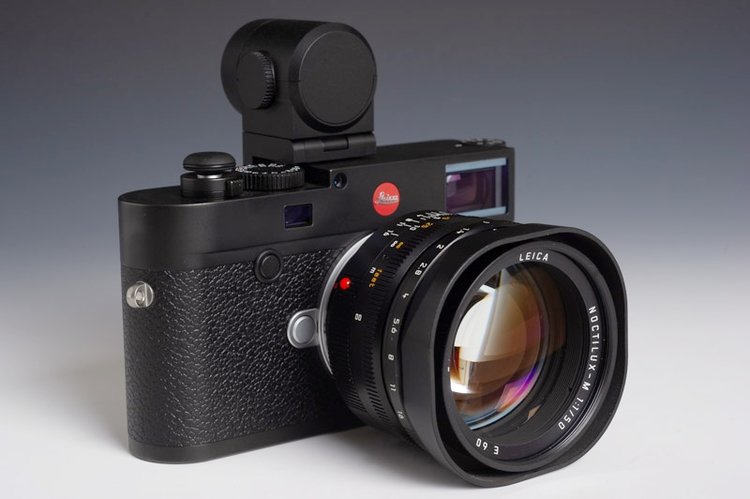
Unfortunately, not only does my Leica not have back button focus, it also lacks auto-focus completely. Everything is manual, either using the rangefinder, the LiveView rear screen, or a Visoflex.

Leica Visoflex

Sadly it’s dark when i start working and when i park my car in the street it’s dark again.
The rainy overcasted weather during the day (and night) doesn’t appeal either.
Besides the lack of time i have when driving around working.
The weekends are filled with tasks…(and now a complete lockdown till 14 of januari…)
No complain, it is as it is. Just wake up and push forwards every day till it’s done.

I did hang some peanuts in the garden and the birds found it so next week(holiday) i try to get some image’s with my new 35-100mm f2.8 during the day. Not much to do anyway :yum:

I feel very sad for you, and for that matter, so many people who are being hurt by this virus - that three years ago, nobody even imagined.

In some ways, I think “photography” for me is maybe an escape from reality. It’s difficult to be overwhelmingly depressed by the virus, while excitedly trying out new things connected to photography. I wonder if I would still be taking photos if there was a “doomsday asteroid” coming at us.

Does your lockdown mean no going to work until mid-January?

No, my work is repairing office printers and lots of them are at schools who need prints for the homeworking kids. Besides the printers are out there waiting to be visit by me.
Which is much better then working at home talking to a screen and the cat walking over your keybord all day!

Thanks,

The sad reality is that it probably could have been prevented if there were not so much antivaxers and fewer festivals in the summer. They locked now everything to prevent lots of holidayshopping and party’s at home. We must the new version is very active and we are near code black in the hospitals.

We will get third shot in the form of a booster as soon as possible which hopefully opens up the possibilities to get some freedom back.
It’s what it is.People are got or getting sick, very sick and me and most of the people i know didn’t a so positive remark.

Peter

Suggestion - pack a camera in your tool kit. You never know when you might spot something worthy of a photo while driving around. :slight_smile:

I’ve got some bizarre kind of radar - I’m constantly seeing things that are worthy of a photograph. I used to make a point of always wearing a camera.

Be thankful - at least you’re working…

Don’t rely on me, it could take too long. I’ve already got all the mirrorless cameras I need with my Ebony 5" x 4" :stuck_out_tongue_winking_eye:

Well you’d be wrong. It’s something I’ve never used, possibly because, although I am right-handed, I am left-eyed and my face gets in the way of any buttons on the back of the camera. I just half-press the shutter and hold it for reframing after measurement, or use manual focus and/or exposure.

An excellent idea. During one of last year’s lockdowns our “permits” allowed us only to go shopping or other essential trips but they didn’t specify the nearest shops or the route we took on the way to the shops. So, as long as we didn’t make the journey unreasonably long, we were able to take a route that had “possibilities” :wink:

What was most frustrating was that we live only 2 km from a massive empty beach but were limited to going for exercise to a radius of of 1km from our house and 1 hour time, even though we live in the middle of farmland. We were limited to walking around a bare field. Even more frustrating because we were allowed to travel 20km to a crowded supermarket but not the empty beach.

I’ve been doing this for so many years now that my grip on the D750 includes having my right thumb on the button no matter which eye I use. I naturally use my left eye on the viewfinder, but I prefer using my right eye because I can then see the scene in front of me with both eyes. If I press the back-focus button once, the camera instantly focuses. If I hold that button in, the camera remains in auto-focus, and tracks whatever I’m looking at (as long as it’s centered in the frame).

I guess this depends on what I’m looking at - for sports, this seems almost essential. For “landscapes” there is no benefit for me, but I do it out of habit. (I really miss this on my Leica cameras!)

Doing it the old way, if I want to take more than one shot, and the subject isn’t in the middle of the frame, my camera re-focuses for every shot, so I need to be moving my camera back and forth, once to focus, and then to shoot.

So are you saying that you have disabled auto-focus on the shutter release?

@mikemyers

just checked my D750, which is (always) set for AF-C, Group mode, back button …

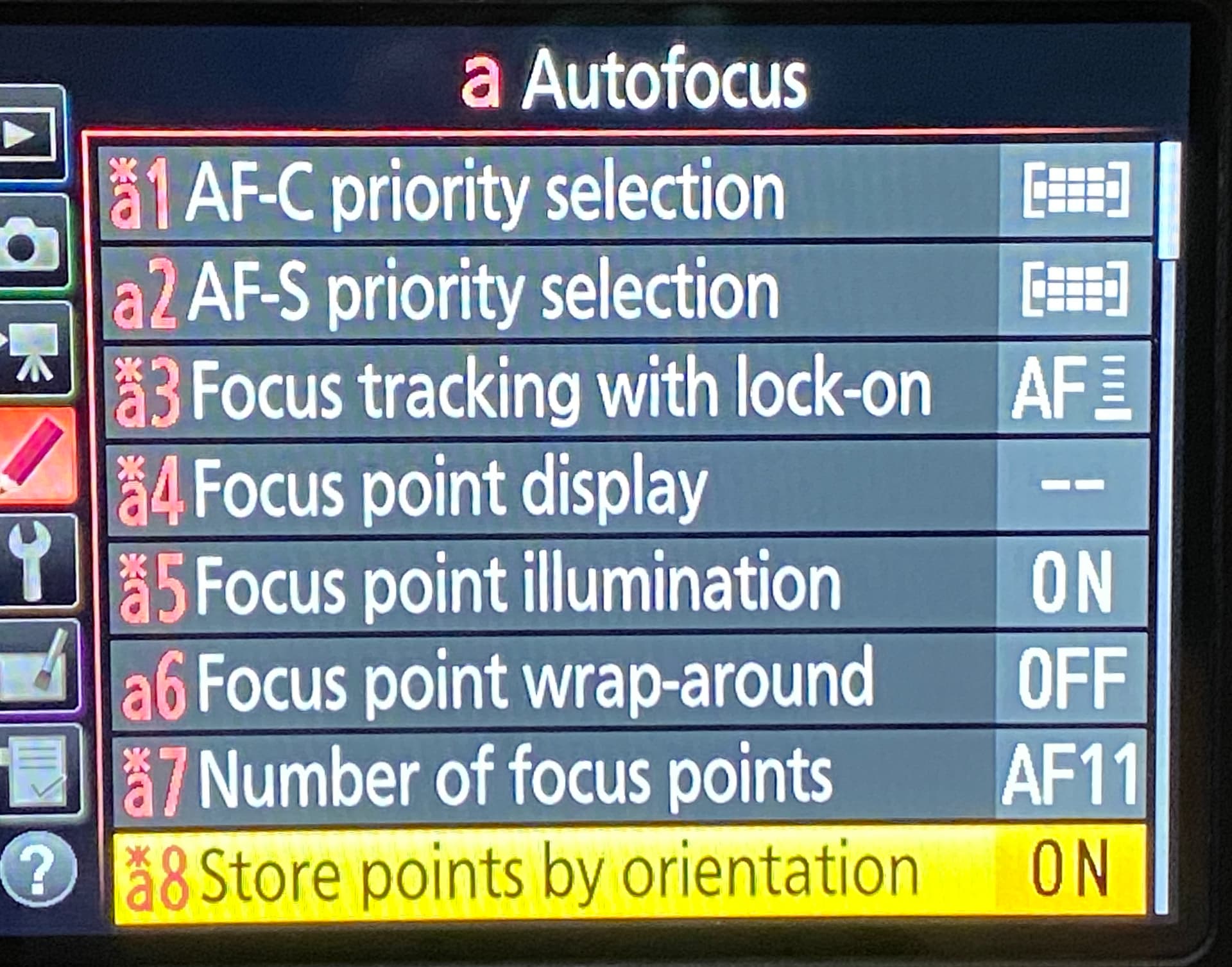
From the Setup menu I’ve chosen “a8 Store points by orientation = ON”.
Like this, in landscape orientation the cam presents focus point in the center and in portrait ‘mode’ higher up, just how I used it last time … being ready to shoot …

I just checked, and I also have that turned “on”. I set this (and everything else) about four years ago, after watching a video on “the best settings for a D750 for shooting weddings”.

Thank you - a week or two ago I was wondering why my D750 was doing that, but never got around to trying to figure it out. If I press the button once, I get single auto-focus, but if I hold it in, I get continuous auto focus. These are my settings:


This is the video I used. I followed almost all his suggestions, which I did find very useful the more I thought about it:
D750 Settings

Ah! Found it! Interesting. I have set up my D850 for back button only, but with the “a8 AF activation” setting available on the “my menu” menu and the fn2 button set to show “my menu”, just in case of panic and needing to switch back to the shutter release for continuous AF while shooting surfers or anything else that moves quickly.

Interesting. I shall give this a go.