You shouldn’t say sorry unless you mean it.
1 Like
I do mean it. I love using PhotoLab and don’t like seeing its user base shrink regardless of the reason.
Mark
1 Like
Great idea for a Kickstarter for a Linux version. My money is ready as well. PhotoLab is the main program keeping me on macOS at this point (Mailmate is the other but is more easily replaced than PhotoLab).
@mwsilvers You show both your age and your biases with your indignant anti-Linux responses. There’s two generations of power users who are fed up with both Apple and Microsoft and their spyware telemetry and are willing to put their wallets where their mouth is.
2 Likes
I have no personal bias against Linux. If DxO decides that they have the resources to develop and support Linux versions of their software and will profit from it, I say more power to them.
My concerns are simple. The costs and resources necessary to do this would likely have a negative impact on the development and support efforts for the existing platforms and for me that would be a negative since I am not personally interested in Linux.
However, DxO has also made it clear on this forum and in private conversations I’ve had twice with them over the years that they have no interest in pursuing developing their applications to Linux. I also wondered whether or not a sufficient market for DxO’s. premium priced photo software exists on that platform.
While I do not have a definitive list, I believe that most of the current post-processing photography software running on Linux are open source titles. As far as I know none of DxO’s main commercial competitors has a Linux version. However, if there is a large enough market for DXO software on that platform willing to pay for their very expensive suite, and they have the resources to accomplish this, from a business perspective I would consider it if I was the owner. But, I don’t think this will be on their radar anytime soon, if ever.
Do you believe that a large enough untapped market exists and it is worth the time, effort and cost for DxO to pursue it? If DxO decided that this market exists, nothing that any of us here could say would dissuade them from taking the plunge.
Mark
1 Like
To be fair both were very poor products and uncompetitive. More a reflection of Corel and not Linux. Corel also used to have a spreadsheet and office suit……………….. I suppose the death of those was Linux’s fault too? 
The biggest problem is that DxO have a plethora of problems on Windows machines and MACs, their chances of getting a Linux version that works out before the second half of the century is negligible.
That’s the whole point. There’s lots and lots of photographers who would like to move to Linux but still want a top-tier RAW developer with commercial polish. There’s only three on the market: PhotoLab, C1, Lightroom. If PhotoLab gets there first, there’s lots of mindshare to be had (which will rub off on the other platforms). Moreover, the venture would pay for itself if done efficiently.
Step one could be a Wine version with the rough edges rounded.
The Windows drones with your “never” “not advisable” “inappropriate use of resources” seem to lack any marketing sense or any ambition to see beyond your Excel spreadsheets.
Learn to read the sky and feel the wind. There’s a big world beyond Windows and macOS now. Linux has long been not just neckbeards and CLI junkies. Long-time Apple users spend far more on software per person than Windows users and we’ll be happy to spend on Linux too.
2 Likes
This is starting to sound like a philosophical discussion.
If DXO, which is a fairly small for profit business, sees the potential for profitability by creating a Linux version then they will do it. So far they haven’t shown any interest and that is probably unlikely to change. I don’t work for DxO and I’m not a spokesman for the DxO. but I can understand their lack of interest if the potential risks outweigh the potential rewards. They are struggling to compete on the two platforms they currently support and I believe they are not motivated to bite off more than they can chew.
Some of the conversation in this long thread almost seems to suggest that it’s DxO’s obligation to create a Linux version because it’s a growing and changing platform with users who want an alternative to the Apple and Microsoft platforms that they seem to detest. There are obviously good reasons for some Linux users wanting to have native access to DxO’s products on that platform. The only question is whether doing so would be a good business decision for DxO. I presume at some point DxO has performed some sort of cost/benefit analysis for a Linux version, but so far they have not publicly indicated any interest in proceeding. What more is there to say?
While I am a Windows user I understand some of the valid reasons why Linux users prefer it over Windows. However, ultimately I don’t give a crap about the operating system, all I care about is the software available on it and whether it meets my needs and performs to my satisfaction. Right now, for me, that platform is Windows.
Mark
The main commercial competitor has one indirectly, as noted in an earlier message: Adobe Lightroom has a web version that can be used under Linux, so for Adobe clients I guess this isn’t a major issue (but I haven’t tested it: it may lack features).
The main open-source competitor, Darktable, is indeed available for Linux (AppImage by default, then distributions can ship their own version if they want), Windows, MacOS ARM & Intel, uses GTK3 for its cross-platform interface, supports USB camera connection through the gphoto2 library, has its perspective correction tool too, uses the Lensfun project as “a open source database of photographic lenses and their characteristics”, has satisfying noise reduction by default without forcibly installing tens of GBs of AI models, directly supports exports to a bunch of formats including WebP and JpegXL, uses OpenCL as well for GPU-accelerated operations, and relies on noise profiles and sample RAWs provided by its users: while being way more technical than PhotoLab (and even Lightroom), if you know what you want (including localized effects) you’ll likely be able to do it, and if your camera isn’t supported then it’s up to you to send samples.
As I don’t want to give Adobe a single cent, given the responses in this thread I’m slowly learning to use Darktable even if it can’t be considered as a 1:1 replacement at all (especially if you use FilmPack presets or rely heavily on AI-based noise reduction), but I prefer the ease of use of PhotoLab and would keep paying for it if I could use it again.
As stated a few times above, if they can’t manage two platforms then it means that they need to change their approach for another one that allows for more unified developments: pushing them to continue on their current path (which is, according to many posts on these forums outside of this thread, failing)… won’t help them in the long run.
Caring about the available software on an OS primarily is why Windows users should ask for a Linux version in advance as a safety net to be able to “jump ship” on time when the Windows enshittification becomes too much for them: the threshold has already been met for many and I don’t see the tide reverting soon given the governance at Microsoft.
And no, switching to Apple is not an option for most people either as it implies buying a new expensive machine (even if nowadays PCs are also expensive because of RAM prices, you don’t need a new machine to dual-boot to Linux), and seeing reports on these forums of issues with the MacOS version isn’t really encouraging.
EDIT:
As shown previously, if all their employees are on LinkedIn then they are almost 100.
Compared to industry behemoths this is indeed “fairly small” but, in isolation, given all that a single full-time developer can accomplish in a project with a proper technical architecture this is far from “fairly small”.
2 Likes
I rest my case. It must have been very difficult to fire you from projects Mr. Silvers. You make the world’s best corporate waffles.
1 Like
It it easy to be a risk taker when the money you are risking is not yours. Remember that DxO went through a bankruptcy in 2018. You think I am somehow afraid of risk. That is not true, but I am a pragmatist when it comes to managing business risk especially when a major business error could destroy a small firm like DxO. Windows has a market share of 65% to 70%. MacOS has around a 16% market share. However, Linux has a market share of only 4% to 5%! There is a reason why most commercial software companies with Mac and Windows versions of their software don’t also have a version running on Linux.
Mark
3 Likes
For reference I’ll use Statcounter, desktop worldwide, between January 2009 and November 2024.
It was 95.42% in 2009 and is now at 69.37%. The trend is there and it’s only falling.
Only counting OS X (and not iOS) it was at 3.68% in 2009 and is now at 8.26% (with a peak at around 20% in the second half of 2023).
I think the PC RAM prices and the Windows 11 fiasco will boost these numbers, so indeed OS X isn’t a platform to stop supporting, it’s here to stay with a dedicated and commercially viable base.
It was 0.64% in 2009 and is now at 3.07% (with a peak at around 4.55% in the summer of 2024) on the purely “Linux” line.
But if you add to it Chrome OS (basically Linux, and not in the Android way where many things are different) + the “Unknown” category that now contains all the new Linux distributions like CachyOS that aren’t yet counted as “Linux” (the same way that this category contained new Windows versions before they were correctly classified as Windows, the graph is very telling), the combo went from 0+0.64+0.17=0.81% in 2009 to 1.3+3.07+13.14=17,51% in late 2025.
And I’m not even counting the “Other” category that accounts for around 5% because I think (given its rise in 2025 only) that it’s mostly automated scrappers for AI tools (so it may slightly impact the accuracy of the rest of the graph).
In short, the number of Linux users could now be more than twice the number of Mac users, as crazy as it seems, and in this projection (which could be wrong) the Linux market share grew >21 times while the Windows one shrank ~27%.
“But there are so many distributions to support!” some say, but this is why the AppImage format exists: it’s basically OS X’s .dmg format (an archive of the application and its dependencies packaged into one file) and one AppImage (for a given architecture like x86_64) can run on all distributions (even Chrome OS).
Given these trends, if you were an investor, which platform would you invest in RIGHT NOW?
1 Like
You are forgetting a very important detail. DxO is not an investment firm. It is a relatively small risk averse software publisher. You can spin this any way you want but, in the end, DxO is simply not going to create a Linux version of their software in the foreseeable future unless perhaps they are bought out by some large company with deep pockets.
Mark
2 Likes
You are forgetting a very important detail. Investing is the core of a company’s activities: they invest in human resources (experience, training and retention), in R&D and projects, sometimes in acquisitions, to adjust to ever-changing market conditions (customers expectations, competition, trends, …).
They choose to invest, presumably a lot, in AI developers and AI models that require 16GB of RAM + 6-8GB of VRAM to run (see PL9’s release notes) and that many users have trouble to run.
Training the models isn’t free (neither in computing or in training data), even using ONNX as they did.
But they thought at the time it was a better bet than preserving or increasing their potential reach.
I guess we’ll soon see where they invest the money from our licences next.
2 Likes
As mentioned, they seem to employ over 100 hundred people in a very focused software company. They are building and “tweeking” a ready for market product. (I say that very loosely). More accurately - used to be ready for market.
That’s actually a lot of people focused on photo editing software alone.
They have investment from a private equity company and as such the need to hit the target date for PL9 was paramount. The PEC are expecting income to be streaming in at this stage and any delay would be problematic. Hence why it has come out far earlier than it should.
DxO (Photolab et al) is now a different company to DxOMark.
1 Like
All this sounds great, but I don’t believe that even Adobe which is a huge company with a huge amount of resources and thousands of its staff members specifically focused on product development has decided to tap this growing Linux market. I wonder why? Again, all of this is just talk. You are wasting your time trying to convince me that DxO should reallocate a significant portion of its limited resources away from Windows and MacOS to Linux development. I have no vested interest or say in the matter. You just have to convince DxO, which so far has also shown no interest.
Mark
3 Likes
This is either disingenuous or naïveté, Mark.
Adobe does not build for Linux, not because they would not make money from Linux versions of their products (with their market share of course they would). Adobe does not build for Linux as they are part of the US big tech cabal which has been running a complex operation against an open source OS and privacy for the last thirty years. Yes, there are exceptions like when IBM and Microsoft participate in FOSS/Linux. But hold onto your wallets and your passwords, it’s mostly embrace, extend, and extinguish. Where is Nokia these days after their Microsoft shotgun wedding, where is Skype, what happened to GitHub? All of our FOSS code has been expropriated to train AI without attribution.
The French directors of DxO delude themselves that they are part of US big tech. Consequentyly they force their users to upgrade their OS at a frenetic pace and push sales of the latest Apple computers and high end Nvidia graphic cards. What recompense or reciprocity DxO hopes to gain from Apple, Nvidia or Microsoft is a mystery. Clearly they have not read the business histories of these companies. Small fry and foreign companies at best can hope to be ignored by US big tech. At worst, they are to be eviscerated and devoured.
The people who might be loyal to DxO are their users, but unfortunately management has declared a cold war on their users. Releases on a schedule which makes no sense. ViewPoint and FilmPack don’t need bi-annual updates, PhotoLab should be on a bi-annual schedule. There’s no reason that any owner of PhotoLab Elite should need FilmPack for luminance masks or fine contrast. Reducing renewal periods to one version for FilmPack and ViewPoint and Nik (drove me off of Nik, last time I lost my money at Nik poker was v3 and I won’t be back due to the update policies), with just two version for PhotoLab is extremely anti-customer. Building their software to phone home every time you use it and require activation every three weeks, is extremely anti-customer.
The point is that DxO should show more loyalty to their users so we would go to DPReview and sing the praises of their software instead of complaining about it to one another here. Shutting down these forums, which no doubt is a weekly conversation at DxO headquarters would not fix the problem, it would mean that users would lose that last sense of community. I don’t feel any unity with corporate DxO who don’t have my interests at heart, but I do feel a strong sense of community with many people here like @Stenis @Joanna @platypus @Pieloe @Wlodek to name just a few.
Even you on a good day @mwsilvers, though gradually your posts have started to shill so hard and so ubiquitously for DxO corporate that I’m sometimes start to think that you are an Anglo persona invented by the founder of DxO to hammer home company policy on every thread. 
Returning to the Linux issue, there is a market for a top-tier RAW development tool and photo manager on Linux. It’s not a question of money as you keep carping. The initial test of a Wine version wouldn’t cost much and could be discontinued after one or two versions if it doesn’t fly. Running a Kickstarter to test the water wouldn’t cost much and if it succeeds would fund all Linux development and support.
The real problem is one of mentality. There’s no sense haranguing us all with your US big tech obsequity. While you’d like to live in 2010 forever where Linux on desktop is safely held beneath 1% market share and Windows rules the waves, it’s over, Mark. The world is changing. In most cases it no longer costs millions of dollars to create alternate versions, the frameworks are cross-platform and universal.
DxO can get ahead of the wave for once. Or continue to follow along behind Adobe and Apple picking up the crumbs, mumbling thankyumassa.
3 Likes
Alec,
I don’t think I am being disingenuous or naïve to believe that DxO has shown no interest in investing their money or resources to port their applications to Linux. If they have absolutely no intention of doing it then this 258 post thread, has served no useful purpose other than for those in favor of it to vent their frustration to other users.
As I have said before, if DxO is able to port their PhotoLab suite to Linux and provide support for it, without any significant negative impact on development and support of the Windows and MacOS platforms, I would support it. Do those posters in this thread supporting that effort really believe that there is a reasonable chance that will happen? Perhaps I am not the one on this thread being naïve.
Mark
1 Like
OK, all you Linux fanboys. Maybe you are sandal wearing, beard sporting Linux geeks but, take a look at the situation from a non-computer-savvy photographer’s point of view.
I went on to the Lenovo site to find a high end PC/Linux laptop…
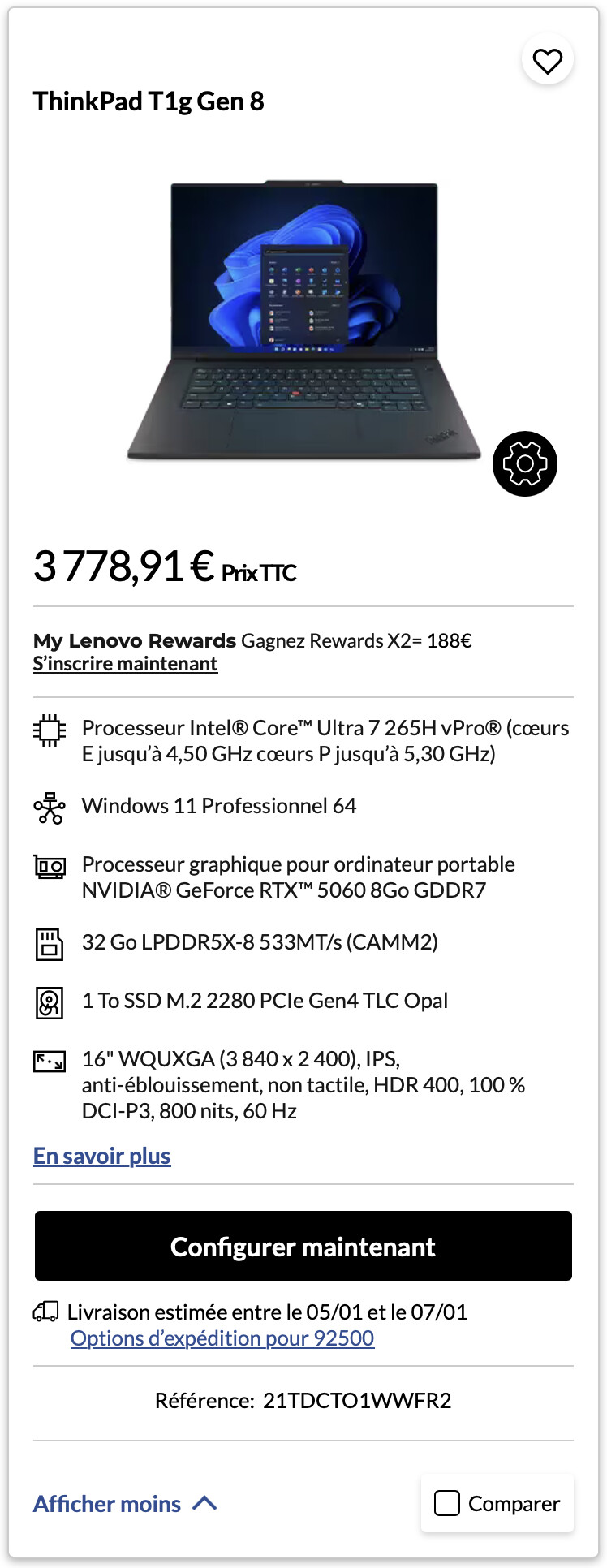
Now go onto the Apple Store for a comparable MacBook Pro…
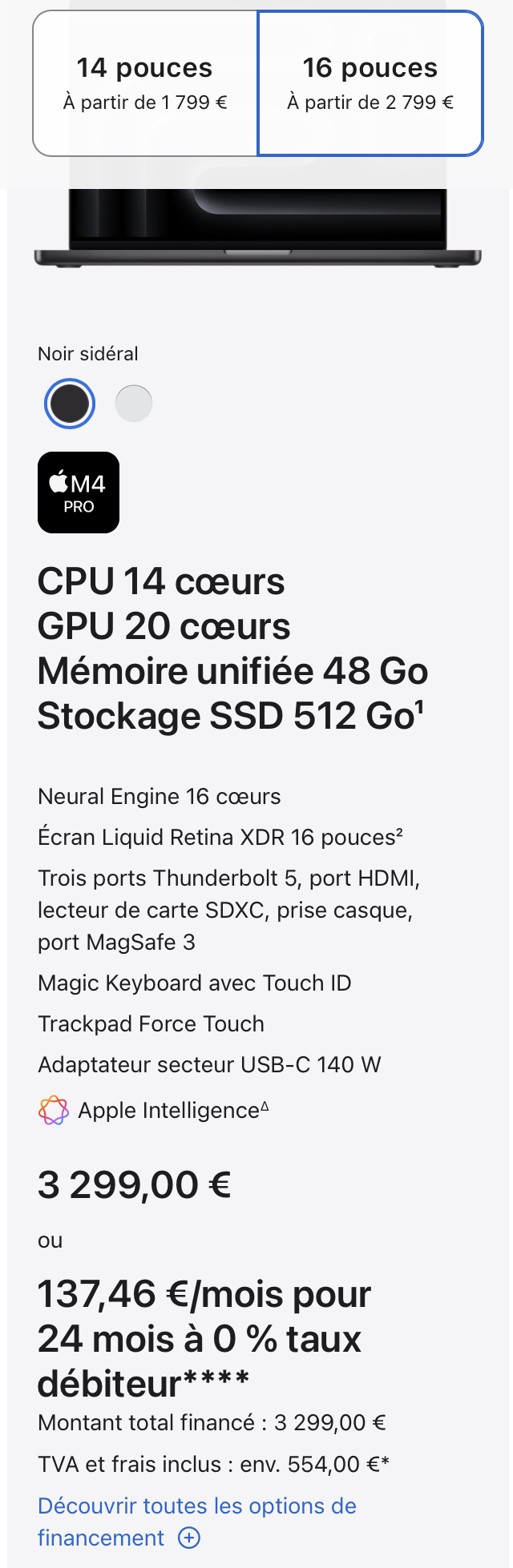
What’s this? A MacBook Pro for less than a Windows/Linux laptop?
But, to get Linux, I would have to buy the laptop without an OS and then choose which distribution would be compatible with the Linux apps I want to run.
But imagine I am not at all computer savvy. Do I choose a Linux distribution that suits my photo editing app, or that suits other apps that do not necessarily support the Linux distribution that supports the photo app?
How do I, as a non-savvy photographer install the Linux distribution? Oh, you say, you will need to use the command line. The command what?
Now, imagine that I manage to get my laptop up and running with a mutually suitable Linux distribution, I then find that I, once again, have to resort to that command thingy and find appropriate calls to install the photo app.
But, as I mentioned before, this is all beyond my comfort zone. All I wanted to do was to buy a computer, install a photo app and start work.
So, let’s say I take the path of least resistance and buy the laptop with Windows ready installed.
Now, all I have to do is download the installer, using a graphical UI and run it. Moments later, I can start work.
But, since a MacBook Pro costs less, for the same high-end specification, why not buy one of those, download the DMG bundle for the photo app and drag the app from the DMG to the Applications folder.
Yes, I have tried out Linux, many years ago, when Borland released a Linux development environment called Kylix. It took me days to get Linux installed, only to find I had the wrong distribution, so back to square one and, when I saw the absolutely awful UI, both for the OS and for the apps, I didn’t get any further than building the demonstration “Hello World” app. After a week, I abandoned the whole idea and reverted to the comparative sanity of Windows.
I keep hearing that DarkTable is highly rated for use on Linux so, since it is also available for macOS, I downloaded it and took it for a spin.
What a heap of unadulterated s**t! I also attended a session by one of our club members who is a fan and got totally lost in the first five minutes. Such a complicated UI. If that’s the best for Linux, I’d hate to see the worst.
But then I’m highly unlikely to ever venture anywhere near Linux again. I have retired from full-time software development work to concentrate on my photography.
What’s more, by using a Mac, I get loads of free apps included in the price Apps included on your Mac – Apple Support (UK)
What is more, I can use the productivity apps, transferring work from MacBook to iPad, to iPhone, just by hiding the mobile device near the MacBook. My most common use of that scenario is to use Google Maps on the MacBook to explore which route to take, transfer it to my iPhone and then, when I get in the car, it’s available on the car’s screen, ready programmed.
So, I no longer have to be a computer geek, I just use my computer to edit and print my photos, which is, for the most part, what photographers want to do with their computers.
Yes, I do wear sandals, but I don’t have a beard
6 Likes
You don’t have a beard! No seriously sorry for the jibe.
I have to agree with you 100%. No small company could afford to employ people to programme for the various flavours of Linux. It would bankrupt them in very quick succession. I must admit though. I do have a couple of Raspberry pi’s. But that is just to try and keep up with them.
1 Like